We’re Recruiting: Funded PhD Positions Available
Two Funded PhD Positions Available in the Zhou Lab

The Zhou Lab at the University of Guelph is recruiting two funded PhD students to join our research program in biodiversity genomics, evolutionary biology, molecular ecology, and biological interactions.
Recruitment is open immediately, with expected enrolment in September 2027 or earlier by mutual agreement.
Position 1. Evolution of Larva–Worker Communication in Honey Bees
This project will investigate the evolution and molecular basis of communication between honey bee larvae and adult workers. Brood care is fundamental to honey bee social organization: developing larvae depend on adult workers to respond to their nutritional needs and adjust colony-level food acquisition and provisioning accordingly.
Our recent research has identified molecular connections between larval chemical communication, worker nutritional physiology, and brood provisioning, providing an opportunity to investigate how this communication system originated during bee social evolution.
The PhD will combine comparative genomics, molecular and functional biology, chemical ecology, and evolutionary analysis to investigate the molecular mechanisms underlying larva–worker communication and reconstruct their evolutionary history across bees. A central goal will be to understand how molecular mechanisms originally serving other biological functions may have been recruited and modified during the evolution of complex social interactions.
The project provides opportunities to work across molecular, organismal, and evolutionary scales, from experimental studies of honey bee biology to comparative analyses across diverse bee lineages. Training will also include honey bee husbandry, and the student will participate routinely in the operation and maintenance of research colonies.
Position 2. Subarctic Pollination Networks and Biodiversity Genomics
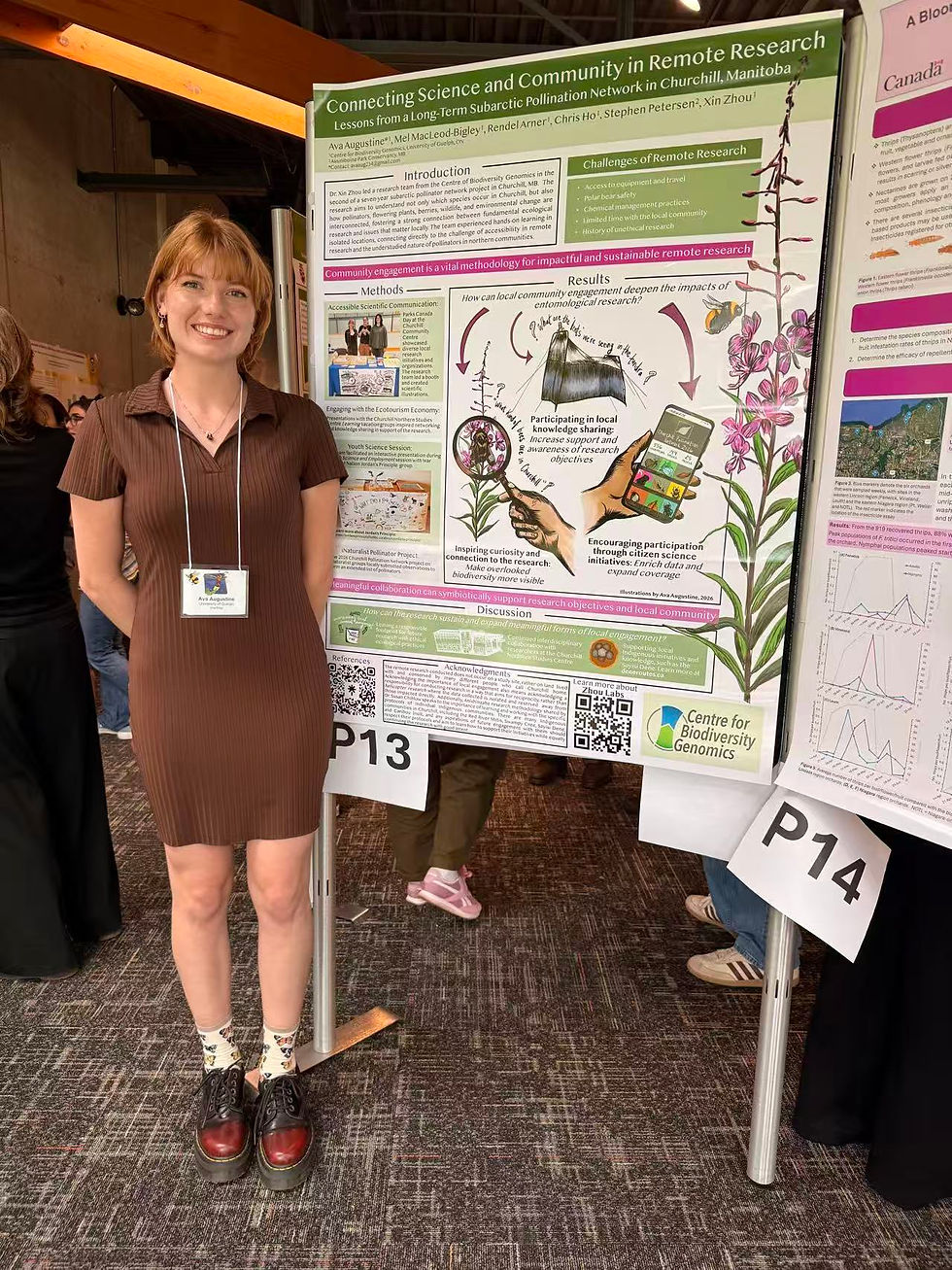
This project will investigate pollinator biodiversity and ecological interactions in the Subarctic, using the Churchill region of northern Manitoba as a focal system.
The project asks three connected questions: Who are the pollinators of the Subarctic? How are they connected with flowering plants through pollination networks? And how might environmental change alter these interactions and their ecological consequences?
The student will develop an integrative framework combining specimen-based taxonomy, DNA barcoding and other genomic approaches, field ecology, molecular identification of pollen and gut contents, bioinformatics, and ecological network analysis to characterize pollinator communities and reconstruct plant–pollinator interactions.
A particular focus will be placed on locally important berry-producing plants, providing an opportunity to investigate how environmental and phenological changes may affect berry pollination and how these effects could propagate through northern food webs to wildlife and local communities that depend on berry resources.
The project includes opportunities for substantial fieldwork in Churchill and for the student to develop their own research questions within the broader research framework.
Research Environment and Training
Both students will join the Zhou Lab in the Department of Integrative Biology at the University of Guelph, led by Dr. Xin Zhou, Professor and Tier 1 Canada Research Chair in Eukaryote Biodiversity Genomics.
The lab integrates biodiversity genomics, evolutionary biology, molecular ecology, and functional approaches to understand biological diversity, adaptation, biological interactions, and responses to environmental change.
Students will benefit from the broader research community in ecology, evolutionary biology, molecular biology, and genomics at the University of Guelph, as well as the expertise and infrastructure of the Centre for Biodiversity Genomics and collaborations with research groups at the University of Guelph and other Canadian universities.
Candidate Profile
We welcome applicants with a Master's degree (or equivalent) in a relevant field, including ecology, evolutionary biology, molecular biology, genetics, genomics, entomology, biodiversity science, molecular ecology, bioinformatics, apiculture, animal biology, biochemistry, or related disciplines.
Applicants are not expected to have expertise in all of the approaches associated with their chosen project. Relevant previous experience may include field ecology, insect or plant biology, honey bee biology or apiculture, molecular biology, functional genetics, genomics, DNA barcoding/metabarcoding, bioinformatics, phylogenetics, chemical ecology, R, or ecological network analysis.
For the honey bee project, prior experience with honey bee biology, apiculture, or colony management is an asset but is not required; appropriate training can be provided. The successful student will be expected to participate routinely in the care and maintenance of research honey bee colonies.
For the Subarctic project, applicants should be willing and able to undertake extended fieldwork in Churchill, Manitoba, under northern field conditions.
For both positions, we are looking for students with strong research interests, good written and oral communication skills, and the ability to work both independently and collaboratively.
Admission and Timeline
Applicants must meet the admission requirements of the PhD program in Integrative Biology at the University of Guelph. Most applicants are expected to hold a recognized Master's degree in a related field with a minimum A− (80%) standing in their postgraduate studies. Direct admission from an honours bachelor's degree is possible under exceptional circumstances.
Recruitment status: Open immediately
Expected enrolment: September 2027, or earlier by mutual agreement
Initial application deadline: October 15, 2026
Applications will be considered as they are received, and suitable candidates may be interviewed before the initial application deadline.
How to Apply
For the initial application to the Zhou Lab, please prepare the following as a single application package:
Curriculum vitae (CV)
Unofficial transcripts from all university-level studies
A brief statement (approximately one page) describing your research interests, relevant experience, which of the two PhD projects you are applying for, and why the project is a good fit for your research goals
Names and contact information for two to three academic or research references
Relevant publications or other research outputs, if available
Shortlisted candidates will be interviewed before being invited to submit a formal application to the University of Guelph graduate program.
Contact: Dr. Xin Zhou
Email: xin.zhou@uoguelph.ca


Comments