
Pillar 1
Biodiversity & Evolution
Discovering diversity and reconstructing its history
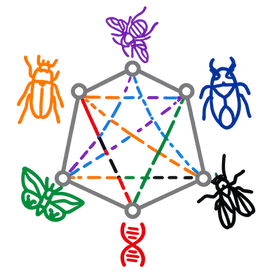
Understanding biodiversity begins by knowing what organisms exist, how they interact, and how they evolved. Our research develops molecular approaches that progress from identifying individual species to reconstructing ecological communities and interactions, before placing this diversity within a robust evolutionary framework. By integrating DNA barcoding, community genomics and phylogenomics, we connect observations made in contemporary ecosystems with the evolutionary processes that generated them.
The long-term goal is to build a unified evolutionary framework that links genomic-scale phylogenies with species-level DNA reference libraries, allowing biodiversity to be interpreted across scales—from individual organisms to ecological communities and the Tree of Life.
What biodiversity exists, how is it organized, and how did it evolve?
1-1

DNA barcoding provides a universal molecular identifier for species. Our research demonstrated how barcodes can associate different life stages, reveal cryptic diversity and build voucher-linked reference libraries. Beginning with freshwater insects, particularly caddisflies, these studies expanded into regional and global initiatives that now support biodiversity research and long-term monitoring, including our current work in Churchill.
1-2
High-throughput sequencing extended molecular identification from individual specimens to entire biological communities. Our work helped establish DNA metabarcoding as a practical tool for biodiversity surveys, developed methods for recovering full-length barcodes from mixed samples and demonstrated how community DNA can be used not only to catalogue species, but also to investigate how ecological communities are assembled.


1-3
Species presence alone cannot reveal ecological change. By developing PCR-free genome-skimming approaches, our research showed that DNA can preserve quantitative information about species representation while recovering complete mitochondrial genomes from mixed samples. These advances move DNA-based monitoring beyond species detection toward measuring changes in community structure.
1-4
Communities are defined not only by the species they contain but also by the interactions among them. Genome skimming of mixed pollen demonstrated that DNA can identify and quantify plant resources carried by individual pollinators, making it possible to reconstruct pollination networks. These approaches now form the foundation of our ongoing Churchill program, where genomic references are being developed to understand how plant–pollinator interactions are organized across the Subarctic landscape.

1-5
Modern biodiversity reflects hundreds of millions of years of evolution. Through the international 1KITE project, our research helped reconstruct the insect Tree of Life, clarifying the origins of major innovations such as flight, specialized feeding and sociality. By integrating phylogenomics with dense DNA barcode coverage, we are extending this framework toward species-level evolutionary trees that connect regional biodiversity with deep evolutionary history.