1-3
Can DNA Measure Biodiversity?
Knowing which species occur in a community is essential, but ecological change is not captured by presence alone. A species may persist while becoming much less abundant, and such changes can alter community structure long before local extinction occurs.
Our research asks whether DNA sequencing can recover not only species composition but also their relative contributions to a mixed sample. This required moving beyond PCR-based metabarcoding, whose amplification biases disrupt the relationship between the amount of biological material and the number of sequences recovered.


From species presence to biological quantity
Metabarcoding can reveal which species are present, but PCR does not amplify DNA from every organism equally. By sequencing mixed samples without targeted amplification, genome skimming preserves more of the original relationship between biological material and sequence abundance.
Can DNA tell us not only who is present, but how much each species contributes to a community?
The quantitative limit of metabarcoding
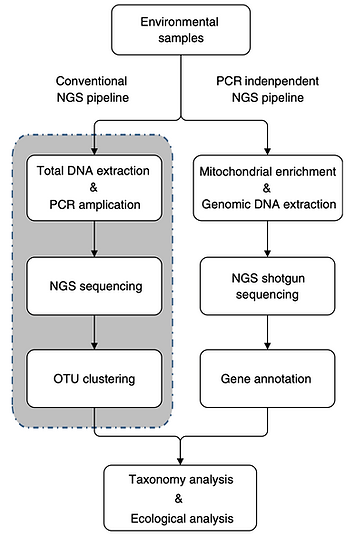
DNA metabarcoding greatly increased the scale of community analysis, but its standard workflow introduced a fundamental limitation. Before sequencing, selected barcode regions are amplified by PCR. Because primers bind with different efficiencies across species, DNA from some organisms is preferentially amplified while DNA from others may be underrepresented or missed.
This bias matters when the goal shifts from identifying species to estimating their relative abundance. After PCR, the number of sequence reads no longer reflects only the amount of biological material originally present. It also reflects how efficiently each species was amplified. Our research therefore explored whether community DNA could be analysed without this amplification step.
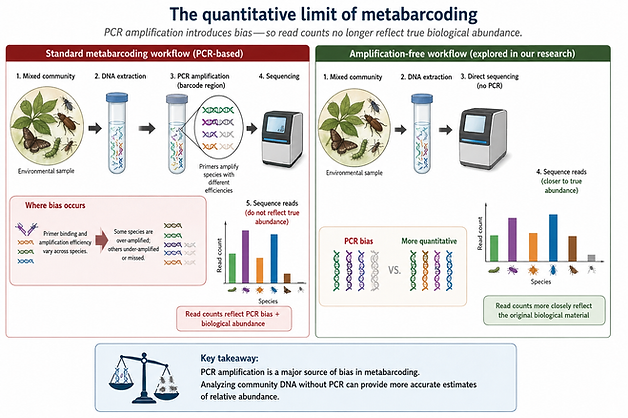
PCR amplification bias in metabarcoding workflows
(AI-generated figure)
Removing PCR from community analysis
We first tested a PCR-free approach using a controlled mixture of terrestrial arthropods. Instead of amplifying COI barcodes, we sequenced the mixed DNA directly and recovered mitochondrial sequences from the resulting data. The method detected almost all species in the sample, produced very few unexpected molecular units and recovered even small-bodied specimens when sufficient sequencing depth was available (Zhou et al., 2013).
More importantly, the amount of mitochondrial sequence recovered showed a positive relationship with species biomass. This provided early evidence that removing PCR could preserve quantitative information that conventional metabarcoding tended to distort. The study did not claim that read number translated directly into organism count, but it established a route toward estimating relative abundance from mixed biological samples.
The approach also revealed its main practical constraint. Mitochondrial DNA forms only a small fraction of total DNA, so most shotgun sequences came from nuclear genomes or other sources. Accurate recovery therefore required deep sequencing, making improvements in reference construction and mitochondrial recovery essential.
From a single barcode to whole mitochondrial genomes
The first PCR-free analysis relied mainly on COI because that was the marker represented in existing reference libraries. Yet shotgun sequencing recovers fragments from across the mitochondrial genome. Restricting identification to one barcode discards much of the available information.
We therefore developed a method for reconstructing mitochondrial genomes from many pooled species at once. Without mitochondrial enrichment or PCR amplification, the pipeline recovered high-quality mitochondrial sequences for all taxa in a diverse mixture, including closely related species. The resulting references contained multiple protein-coding and ribosomal genes rather than a single COI fragment (Tang et al., 2014).

This work extended DNA barcoding into mito-metagenomics, laying the foundation for what is now known as mitochondrial genome skimming (or chloroplast genome skimming in plants). A complete mitochondrial genome acts as a set of linked markers, increasing the probability that a species will be detected even when one gene is poorly represented or degraded. Tests across different sequencing depths showed that using all mitochondrial protein-coding genes recovered more species than relying on COI alone (Tang et al., 2014).
These mitochondrial references also created the foundation for analysing real communities quantitatively.
Measuring wild bee communities
We applied this approach to bulk samples of wild bees collected from farms in England. Reference mitogenomes were first assembled for the regional bee fauna. Total DNA from each mixed sample was then shotgun-sequenced, and the reads were mapped against these references.
The species recovered through mitogenomics closely matched those identified morphologically. Several apparent extra detections were re-examined and were likely cases in which the molecular analysis had exposed errors in the original morphological identifications. Mitogenomics also reconstructed patterns of species richness and differences among bee communities more consistently than the PCR-based metabarcoding analysis (Tang et al., 2015).
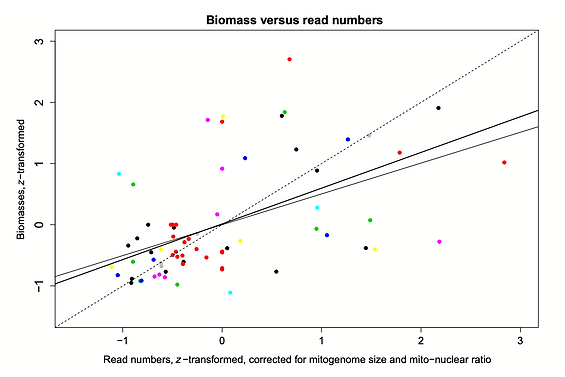
Read frequency significantly predicted the proportion of biomass contributed by each bee species, whereas PCR-based metabarcoding did not recover a significant relationship. The association was not exact because species differ in mitochondrial copy number, mitochondrial genome size and the ratio of mitochondrial to nuclear DNA. Even so, the result showed that PCR-free sequencing retained biologically useful quantitative information and could support the monitoring of changes in wild bee populations over time.
The digital nature of the method offers an additional advantage for long-term monitoring. Historical sequence data can be reanalysed when species names change, errors are corrected or new reference genomes become available. Identification is therefore auditable and can improve without repeating the original field sampling.
Making PCR-free analysis more efficient
PCR-free sequencing avoids primer bias, but it initially used only a small proportion of the generated data because mitochondrial DNA was rare in total genomic extracts. We addressed this problem through mitochondrial capture.
Using mitochondrial sequences recovered from the 1KITE project, we designed probes spanning the diversity of insect lineages. These probes increased the mitochondrial proportion of a mixed sample by approximately one hundredfold while largely retaining the relative representation of the input taxa. The enrichment greatly reduced the sequencing volume required for PCR-free community analysis (Liu et al., 2016).
Capture was not completely neutral. Efficiency could vary with the evolutionary distance between the sampled species and those used to design the probes. This means that mitochondrial enrichment improves efficiency but must be supported by broad reference coverage and evaluated carefully when applied to unfamiliar communities.

Testing whether reads can estimate biomass
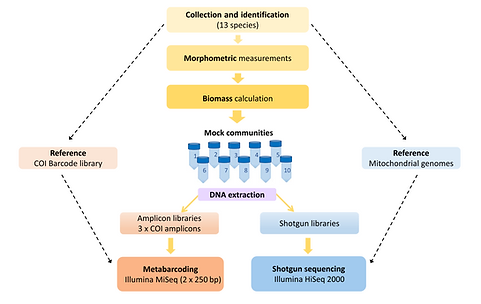
A later comparison using freshwater macroinvertebrate communities tested PCR-based metabarcoding and shotgun mitogenomics against samples whose species biomass was known. Both methods occasionally missed species represented by very little material. The major difference appeared in their quantitative performance.
Shotgun read abundance was positively related to biomass for nearly every species examined. Metabarcoding results varied among primer sets and produced reliable read–biomass relationships for only a subset of species. Combining several amplicons improved some results but did not eliminate the inconsistency caused by amplification bias (Bista et al., 2018).
Genome skimming therefore provided a more reliable basis for estimating biological quantity from mixed communities, but it did not reduce the task to a universal conversion from reads to biomass. Mitochondrial content differs among species and may vary with body tissue, developmental stage and physiological condition. Reliable quantification requires suitable references, calibration and an understanding of the organisms being studied.
The central advance is more measured but still important: removing PCR preserves quantitative biological information that metabarcoding often loses. DNA can therefore contribute not only to detecting community membership but also to estimating how strongly different species are represented.

Why quantitative biodiversity matters
Species presence alone cannot reveal whether populations are stable, declining, or becoming dominant. Ecological monitoring requires information on relative abundance and community structure.
PCR-free genome skimming preserves a closer relationship between biological material and sequencing reads than amplification-based metabarcoding. Whole mitochondrial genomes also provide far more markers than a single barcode, improving taxonomic resolution while creating an auditable record that can be reanalysed as reference libraries and taxonomy evolve.
Although species-specific differences in mitochondrial biology still require calibration, genome skimming shifts DNA-based biodiversity analysis from largely qualitative detection toward quantitative characterization of community composition.
Nest question
Knowing which species are present and how strongly each is represented still does not tell us how they are connected.
Can DNA reveal which organisms feed on, pollinate or otherwise interact with one another?
This question leads to the next feature:
How Do We Reconstruct Ecological Interactions?