2-5
How Will Human Activities Shape the Future of Honey Bee Evolution?
Natural selection has shaped honey bees and their microbial partners over long evolutionary timescales. Human activities are now introducing new pressures that can alter the host genome, redirect microbial evolution and change the relationship between them.

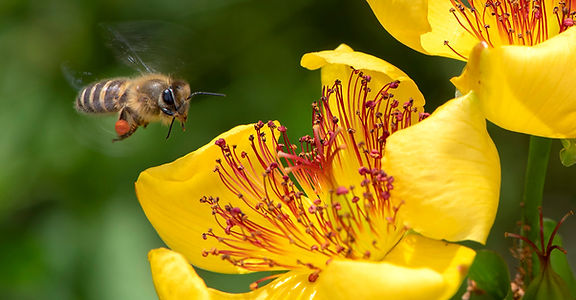


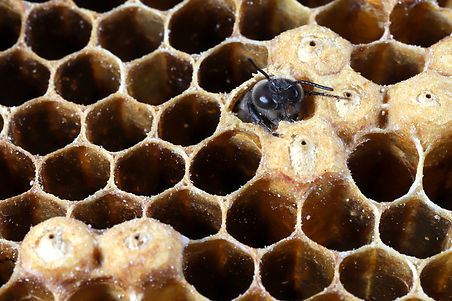
Evolution in the Anthropocene
Natural selection has shaped honey bees and their microbial partners for millions of years. Human activities are now introducing new evolutionary pressures that are changing both genomes over remarkably short timescales, with consequences that may extend beyond the organisms themselves.
How will human-driven evolution reshape the future of pollination?
Looking into the past to understand the future
Predicting evolutionary change requires historical baselines. Museum collections preserve specimens gathered before many modern environmental pressures became widespread, but their scientific use depends on recovering genomic information without unnecessarily damaging irreplaceable material.
We developed minimally destructive methods that retrieve genomic DNA from single legs of century-old pinned honey bees while preserving their external morphology. The recovered DNA was sufficiently rich to support population and evolutionary genomic analyses, transforming museum collections into genomic records of the past (Cavill et al. 2021).
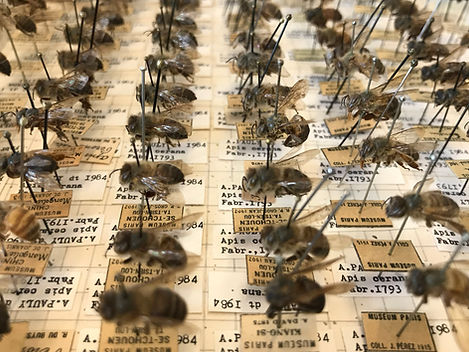
We subsequently extended this approach from the host genome to the entire symbiotic system (Li et al. 2026). Abdominal tissues from historical Apis cerana specimens yielded DNA from both the bee and core gut bacteria, including Gilliamella, Snodgrassella, Bifidobacterium and Lactobacillus. Historical collections can therefore preserve information about both partners in the association, opening a path for reconstructing host–microbiota evolution through time.

Human activities are reshaping honey bee evolution
Comparisons of historical and modern A. cerana genomes revealed that genetic diversity has generally declined over the past century, but the pattern differs among populations (Liu et al. 2026). Clear losses occurred in the Central and Aba populations, whereas the Northeast and Malaysia populations retained levels of diversity closer to their historical counterparts. The Kashmir and Pakistan population also appeared to have declined, although the limited historical sampling requires caution.
The decline in the Central population is particularly important. This population lies near the evolutionary centre from which several peripheral A. cerana lineages expanded and adapted to new environments. Erosion of diversity in this source population may therefore reduce the genetic variation available for future adaptation across the species.
The historical comparison also revealed strong recent selection on genes associated with nervous-system function, chemical responses and nicotinic acetylcholine receptors, which are major targets of widely used insecticides. These signals were strongest in populations with greater historical exposure to pesticides.
A prominent candidate was nAChRα1, a component of the receptor targeted by neonicotinoids. Regulatory variants near one of its transcripts were associated with reduced gene expression in Central China bees. These bees also showed greater resistance to imidacloprid than Malaysian bees, supporting the conclusion that pesticide exposure has driven rapid adaptive change in the host genome.
Recent human influence has therefore produced two different genomic outcomes. Some populations have lost broad genetic diversity, reducing their future evolutionary potential, while selection has favoured specific variants that improve survival under pesticide exposure. Adaptation to one anthropogenic pressure does not necessarily make a population more resilient to other environmental challenges.
Human activities also redirect microbial evolution
The gut microbiota is exposed to agricultural chemicals, antimicrobial use and environmental microorganisms encountered during foraging. Its evolutionary response can occur through changes in gene content rather than through major changes in the core bacterial community.
Comparisons between A. cerana and A. mellifera showed that their gut bacteria carried distinct antibiotic-resistance profiles. The more intensively managed A. mellifera carried a higher abundance of resistance genes and transferable resistance elements than the more semi-feral A. cerana. Within A. cerana, resistance profiles also varied among geographic populations, reflecting differences in local environmental exposure (Sun et al. 2022).
Several resistance genes were carried by honey bee-specific bacteria such as Gilliamella and Snodgrassella. A particularly widespread region contained the sul2–strA–strB resistance cluster, associated with broad-host-range IncQ plasmids. Closely related versions of this region occurred in different gut bacterial species and geographic locations, indicating that resistance genes can move horizontally through the microbial community.

Experimental transfer among Gilliamella, Snodgrassella and Bartonella confirmed that these plasmids can transmit resistance traits between native gut symbionts. Some plasmid-derived regions had also become integrated into bacterial chromosomes or reduced to smaller “satellite” forms, potentially helping resistance traits persist within the microbiota.
Human influence therefore alters more than which bacterial species are present. It can redirect the genetic evolution of long-associated symbionts, turning the microbiota into both a record of environmental antibiotic pressure and a reservoir through which resistance genes may persist and spread.
A changing evolutionary partnership
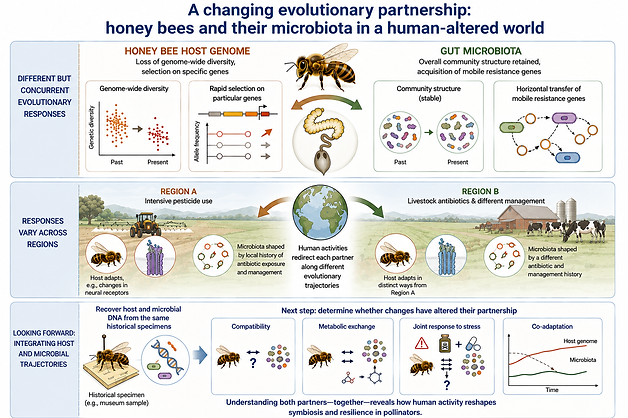
Human activities are reshaping host and microbiota evolution, often along different evolutionary trajectories (AI-generated figure).
Honey bees and their microbiota respond to anthropogenic pressures through different but concurrent processes. Host populations can lose genome-wide diversity while particular genes undergo rapid selection. Gut bacteria can retain their overall community structure while acquiring mobile resistance genes through horizontal transfer.
These responses may also vary independently across regions. A host population exposed to intensive pesticide use may evolve changes in neural receptors, while its microbiota responds to a distinct history of antibiotic exposure and agricultural management. Human activity can therefore redirect each component of the partnership along a different evolutionary trajectory.
Recovering host and microbial DNA from the same historical specimens now makes it possible to examine these trajectories together. The current work establishes the methodological foundation. The next step is to determine whether changes in the host genome and microbiota have altered their compatibility, metabolic exchange and capacity to respond jointly to environmental stress.
Looking ahead
Reduced host genetic diversity may constrain responses to future climates, pathogens and changing floral resources. Pesticide-driven changes in neural and sensory pathways could influence more than chemical resistance, potentially affecting behaviours that depend on environmental perception. Changes in microbial gene content may alter which strains persist under agricultural conditions and how they interact with the host and surrounding microbial environment.
These remain projections that require direct testing. The key question is whether anthropogenic evolution in the host and microbiota changes metabolism, immunity, environmental tolerance and worker behaviour.
The consequences could extend from individual bees to entire colonies. Changes in worker physiology and behaviour may affect when and where bees forage, while microbial changes may influence the condition in which those activities are performed. These effects may ultimately alter interactions with flowering plants, the organization of pollination networks and the ecological functions supported by honey bee colonies.
The future role of honey bees may therefore depend not only on whether populations survive, but also on which host variation is retained, which microbial functions persist and whether this long-established biological partnership continues to support effective ecological interactions.

Why human influence matters
Natural selection shaped honey bees and their microbial partners over millions of years. Human activities now introduce new selective pressures that can redirect the evolutionary trajectories of both partners over remarkably short timescales.
Museum genomics allows us to compare historical and modern populations directly, revealing how genetic diversity, adaptive evolution and host–microbiota relationships are changing through the Anthropocene.