SCIENCE THROUGH PARTNERSHIP
Long-term ecological observatories cannot be built by a single laboratory.
Our research grows through partnerships with local communities, research organizations, citizen scientists and international collaborators who share a commitment to understanding northern biodiversity.
Introduction
Building a long-term ecological observatory is as much about people as it is about science. Repeated observations over decades require sustained collaboration among researchers, students, local organizations and community members. These partnerships provide the continuity that allows ecological records to grow from individual field seasons into a lasting scientific resource.
Our vision extends beyond conducting research in Churchill. We seek to build an open, collaborative observatory that supports scientific discovery, biodiversity conservation and environmental stewardship through shared knowledge and long-term relationships.
Working with the Churchill community
The Churchill Northern Studies Centre provides an exceptional environment for research, training and collaboration. Its facilities, logistical support and vibrant scientific community enable students and researchers from diverse disciplines to work together while conducting field research in the Subarctic.
Working in Churchill also creates opportunities to engage with local residents, visiting researchers and organizations that share a common interest in northern ecosystems. These interactions strengthen the observatory while ensuring that scientific discoveries remain connected to the landscapes and communities where they originate.
Ava Augustin facilitated an interactive presentation during a Youth Science and Employment session with War Lake First Nation Jordan’s Principle group

Citizen science and biodiversity observation

The Churchill Pollinator Watch Project on iNaturalist
Understanding ecological communities requires observations that extend beyond the duration of individual research projects.
Citizen science provides an important opportunity to broaden biodiversity monitoring while strengthening public participation in ecological research. Through platforms such as iNaturalist, observations contributed by researchers, students and members of the public complement standardized field surveys by documenting species occurrences, flowering phenology and pollinator activity across broader spatial and temporal scales.
These observations also encourage public engagement with biodiversity, creating an enduring record that benefits both scientific research and environmental education.
Building collaborative biodiversity science
The observatory is designed as an open scientific platform.
Its value increases as new collaborators contribute complementary expertise in ecology, taxonomy, genomics, bioinformatics and environmental science. By integrating diverse perspectives and datasets, the observatory becomes more than a field program—it becomes a shared resource for investigating biodiversity change across northern ecosystems.
Training, specimen collections, genomic resources and ecological observations all contribute to a growing foundation that supports future scientific discoveries well beyond the original research questions.
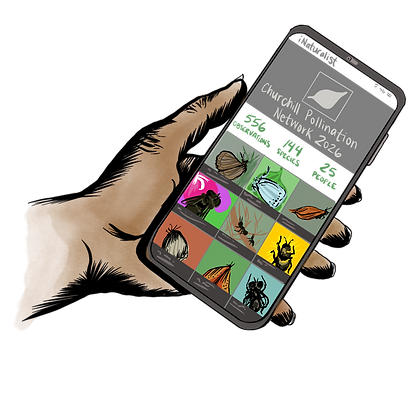
Artist: Ava Augustine
A legacy for future generations
Long-term ecological research is measured not only by the discoveries it produces today, but also by the opportunities it creates for tomorrow.
Every field season expands biodiversity collections, strengthens genomic reference resources, trains new researchers and deepens partnerships with the Churchill community. Together, these efforts build a lasting scientific legacy that will continue to inform biodiversity research, conservation and environmental decision-making as northern ecosystems continue to change.
Our long-term goal is to establish one of the world's leading genomic observatories for ecological communities, providing an enduring platform where biodiversity, evolution and ecology can be studied together across generations.

From local observations to global understanding
The Churchill observatory demonstrates how biodiversity genomics, organismal biology and ecology can be integrated to understand ecological communities. Together, these approaches provide a framework for predicting how biodiversity responds to environmental change across biological scales.
Looking ahead
As environmental change accelerates worldwide, our long-term vision is to establish interconnected biodiversity observatories across diverse ecosystems, integrating evolutionary biology, organismal biology and ecology to understand, and ultimately predict, how ecological communities respond to a changing planet.