1-2
How Do We Reveal Entire Biological Communities?
DNA barcoding identifies one specimen at a time. Ecological samples, however, may contain hundreds or thousands of organisms from many species. Sorting every individual before sequencing limits the speed, scale and consistency of biodiversity surveys.
Our research helped move DNA analysis from individual specimens to mixed biological samples. By combining high-throughput sequencing with barcode reference libraries, we can recover many species from a community at once, compare assemblages across environments and begin to investigate the processes that determine which species coexist.

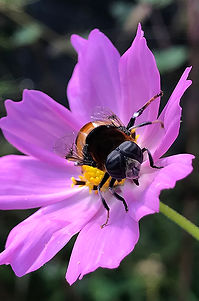
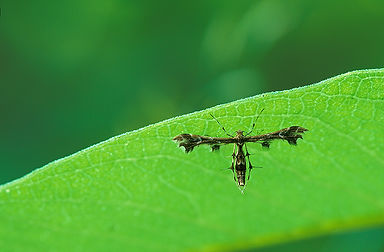
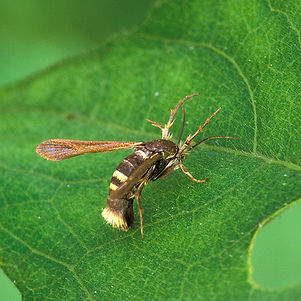
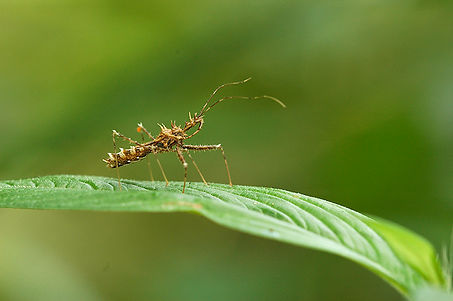
From individual specimens to entire communities
DNA metabarcoding changes the scale of biodiversity analysis. Instead of isolating and sequencing each organism, DNA from a mixed sample can be analysed in parallel and matched to established reference libraries.
Can DNA reveal which species share an ecosystem without identifying every specimen individually?
Reading biodiversity from a mixed sample
Reference libraries made molecular identification possible, but the original DNA-barcoding workflow still treated specimens one at a time. This approach becomes impractical when environmental samples contain large numbers of small, immature or damaged organisms. River biomonitoring illustrates the problem clearly: benthic samples may contain many species, yet larvae often cannot be identified below the family or genus level using morphology alone.
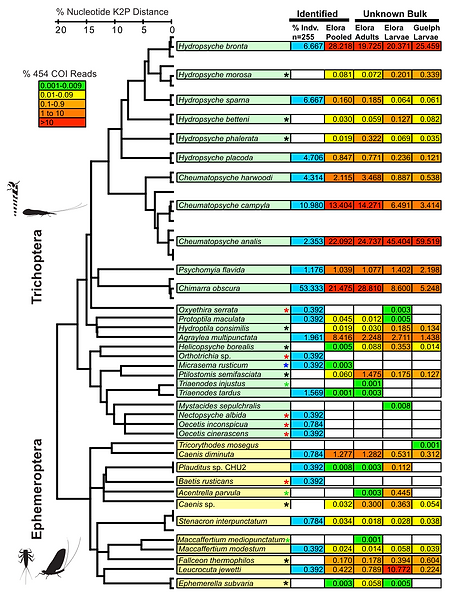
Our early environmental-barcoding study tested whether high-throughput sequencing could recover species directly from pooled freshwater insects. Short COI mini-barcodes were amplified from the combined DNA and compared with reference sequences. The experiment recovered every species that was sufficiently represented in the mixture, although some of the rarest species were missed. It also detected DNA from additional species known from the sampling area, showing both the sensitivity of the method and the need to interpret traces of low-abundance DNA carefully (Hajibabaei et al., 2011).
The same approach distinguished benthic assemblages collected from an urban river and a conservation area. This showed that DNA recovered from bulk samples could support comparisons among ecological communities, rather than merely identifying the organisms in a single collection. It provided an early demonstration of how high-throughput sequencing could contribute to routine biomonitoring.
Recovering the full barcode
Early metabarcoding relied on short DNA fragments because the available sequencing platforms could not read a complete COI barcode from every species in a mixed sample. Short fragments can be informative, but they contain fewer diagnostic characters and may be difficult to match confidently when reference libraries are incomplete or closely related species are present.
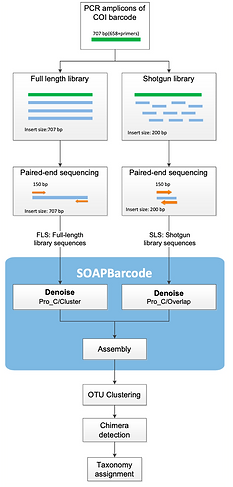
We developed SOAPBarcode to overcome this limitation. The method assembled short Illumina reads from mixed arthropod samples into full-length COI barcodes. This retained the high sequencing capacity of the Illumina platform while recovering the standard barcode region already represented extensively in global reference databases (Liu et al., 2013).
Compared with the earlier sequencing approach, SOAPBarcode recovered more of the species present in the test communities and produced fewer unresolved molecular units. The full-length sequences also improved taxonomic assignment and provided more accurate estimates of differences among communities. Greater sensitivity, however, made contamination easier to detect, emphasizing the need for strict control during field collection, laboratory preparation and data interpretation.
Community analysis still depends on reference libraries
Metabarcoding can recover many DNA sequences from a sample, but those sequences cannot always be connected to named species. This remains a major problem in regions where reference libraries are incomplete. Without a reliable match, a sequence may be recorded only as an operational taxonomic unit, separating the result from existing knowledge about the species’ biology, distribution and ecological role.
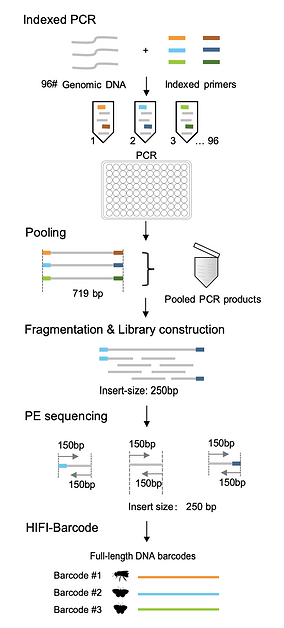
We developed HIFI-Barcode to accelerate the production of full-length reference sequences from individually identified specimens. The method pooled tagged PCR products for high-throughput sequencing and then reconstructed the barcode belonging to each specimen. It produced sequences comparable in accuracy to conventional Sanger barcodes, recovered DNA from many reactions that had appeared unsuccessful and reduced the sequencing cost to approximately one-tenth of the conventional approach (Liu et al., 2017).
HIFI-Barcode addressed a necessary counterpart to metabarcoding. High-throughput analysis can describe communities at scale only when the recovered sequences can be linked to taxonomically validated specimens. Faster reference construction therefore helps translate anonymous molecular diversity into recognizable species and makes community data more biologically informative.
From community composition to community assembly
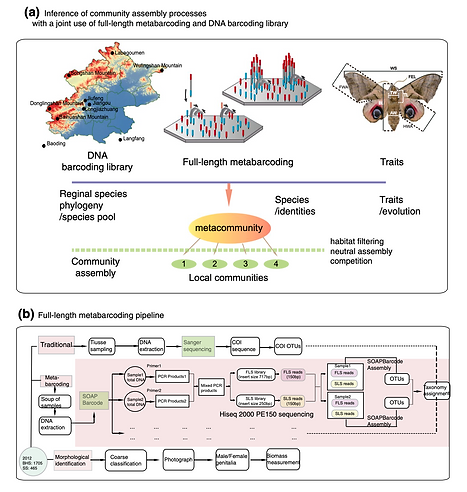
Once species can be recovered from large mixed samples, metabarcoding can address questions beyond community composition. We applied full-length metabarcoding to species-rich moth communities from temperate forests in northern China and compared the results with a reference dataset produced by sequencing individual specimens. The two approaches recovered highly consistent patterns of diversity, showing that pooled sequencing could support analyses previously dependent on extensive specimen-by-specimen processing (Hao et al., 2020).
The study then combined species composition with phylogenetic relationships and functional traits to ask how the moth communities had assembled. The results rejected a simple neutral model in which species were ecologically interchangeable. Most communities in the younger Taihang Mountains showed patterns consistent with competition, whereas habitat filtering was detected at the Wulingshan site in the older Yanshan Mountains. Community assembly therefore differed across landscapes and could not be explained by one universal process.
This marked an important shift in the use of metabarcoding. DNA was no longer being used only to compile a list of species. By connecting community sequences to reference libraries, phylogeny and organismal traits, the same data could help explain why particular species occur together and how ecological and evolutionary history shape community structure.
The study also defined important limits. Community inference depends on representative sampling, suitable biological traits and reliable reference coverage. PCR can amplify species unevenly, while rare taxa remain especially vulnerable to being missed. Metabarcoding can reveal community composition efficiently, but the number of sequence reads does not automatically provide an unbiased measure of organism abundance or biomass.

Why community-scale identification matters
Ecological systems are composed of many species occurring together. Analysing them one specimen at a time restricts the number of sites, seasons and replicates that can be studied. DNA metabarcoding removes much of this bottleneck by recovering numerous taxa from mixed samples in a single analysis.
Its value depends on the foundation established in DNA barcoding. Voucher-linked reference libraries convert DNA sequences into named species, while full-length barcodes improve the connection between community data and accumulated taxonomic knowledge. This makes it possible to compare communities across environments and examine the ecological processes that structure them.
Nest question
Metabarcoding can show which species are present, but ecological function often depends on their relative contributions.
Can the amount of DNA recovered from a mixed sample tell us how much of each species was originally present?
This question leads to the next feature:
Can DNA Measure Biodiversity?