2-1
How Does Evolution Shape Honey Bee Diversity?
Evolution provides the framework for understanding every question that follows. Before asking how particular genes, physiological mechanisms or microbial partners contribute to adaptation, we must first establish where honey bees came from, how their populations diverged and which evolutionary units should be compared and conserved.



Honey bees as natural experiments in evolution
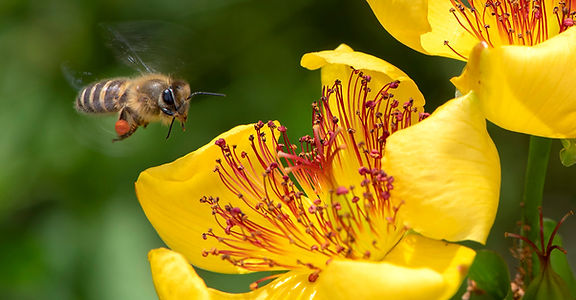
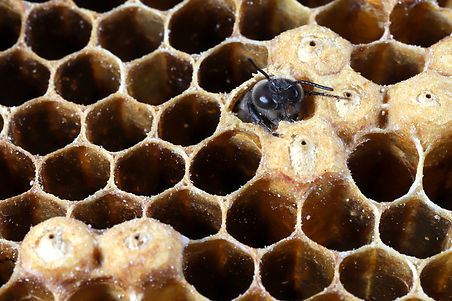
Honey bees occupy environments ranging from tropical rainforests to Himalayan valleys and northern temperate forests. Across these diverse habitats, some lineages have evolved strikingly similar characteristics, while others have become unexpectedly different.
How does evolution generate this diversity?
Placing bees within the insect tree of life
Honey bees belong to Hymenoptera, one of the most diverse animal groups, encompassing sawflies, parasitoid wasps, stinging wasps, ants and bees. Using thousands of protein-coding genes sampled across all major hymenopteran lineages, the 1KITE project reconstructed a time-calibrated evolutionary tree for the order and clarified several major transitions in its history (Peters et al. 2017).
The analysis placed the origin of bees within a lineage of apoid wasps and linked their emergence to a transition from hunting animal prey to collecting pollen. Bees originated during the Cretaceous, broadly coinciding with the diversification of flowering plants. The phylogeny also supported a single origin of eusociality among the corbiculate bees, the group that includes honey bees, bumble bees and stingless bees.
This broad evolutionary framework makes it possible to distinguish traits inherited from ancient hymenopteran ancestors from those that evolved later within bees, social bees or individual honey bee lineages.


A natural experiment in diversification
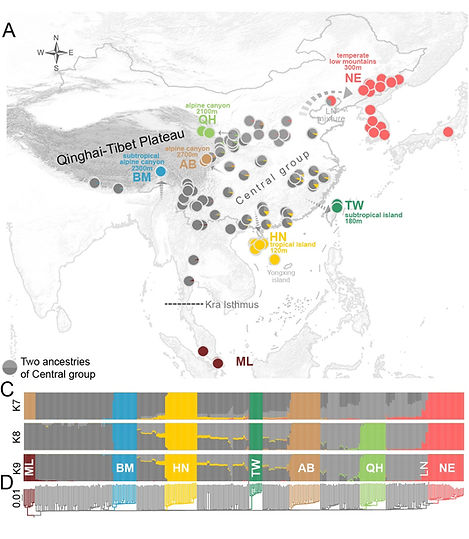
Within the genus Apis, the Eastern honey bee, Apis cerana, provides an exceptional system for studying evolution at a much finer scale. Its native range extends from tropical Southeast Asia to northern temperate regions and high-elevation valleys of the Qinghai–Xizang Plateau. Populations encounter sharply different climates, flowering seasons and floral communities, yet share a relatively recent common ancestry (Ji et al. 2020).
Genome-wide analyses revealed a distinctive pattern of centrifugal diversification. Multiple peripheral populations were derived independently from a widespread Central ancestral population rather than spreading sequentially from one peripheral region to another. Each descendant lineage subsequently adapted to its own ecological setting.
This evolutionary design is particularly powerful. Because several populations began from a shared ancestral source but entered different environments independently, they allow us to ask whether adaptation repeatedly uses the same biological mechanisms or follows a unique path in each habitat.
Different environments can reuse the same genes
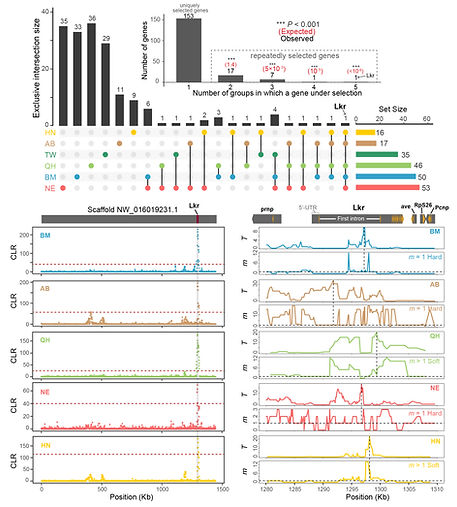
Despite adapting to contrasting habitats, peripheral A. cerana populations repeatedly showed selection on a limited set of genes. The clearest example was Lkr, the leucokinin receptor, which was selected in nearly all peripheral populations.
Functional experiments showed that Lkr influences workers’ responsiveness to sucrose, a trait associated with their tendency to collect pollen or nectar. Repeated selection on Lkr suggested that newly established populations could respond to different floral environments by modifying individual foraging tendencies within the colony (Ji et al. 2020).
The broader evolutionary principle is gene reuse. Rapid adaptation does not always require a new genetic solution for every environment. Natural selection can repeatedly modify an existing regulatory system, producing different outcomes in separate populations.
This finding established the starting point for our later mechanistic work: how does a gene associated with individual responsiveness become integrated with communication among workers and larvae, nutritional allocation and colony function?

Defining diversity through evolutionary history
Adaptive divergence can also complicate classification. Populations exposed to similar climates may independently evolve similar appearances, while closely related populations may look different because environmentally responsive traits change with local conditions.
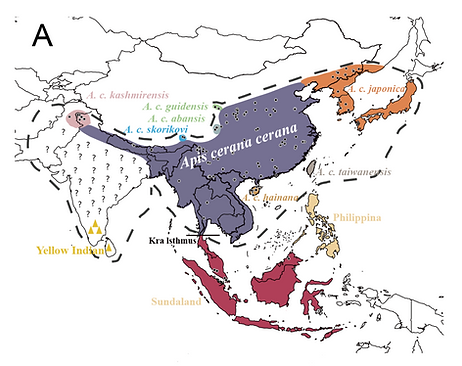
Using genomes, geography and morphology, we identified eight evolutionary lineages within mainland A. cerana: one widespread Central lineage and seven geographically restricted peripheral lineages. Each peripheral lineage formed an independent genetic group, but most conventional morphological traits, including body size and colouration, were strongly influenced by local climate and did not reliably reflect ancestry. Wing venation was less environmentally variable and agreed more closely with the genomic boundaries (Qiu et al. 2023).
We therefore defined subspecies using three connected criteria:
evolutionary independence, diagnosable traits and geographic isolation.
This approach separates inherited evolutionary history from phenotypic resemblance produced by similar environments. It also changes conservation priorities. A widespread population and a geographically restricted lineage may require different management, even when their workers appear superficially similar.
Population divergence is distributed unevenly across the genome
Recognizing distinct lineages does not mean that every part of their genomes has diverged equally.
Comparisons between the Central lineage and multiple peripheral subspecies showed that most of the genome remained relatively similar, while a small fraction contained strong differentiation. These genomic landscapes were produced by interacting forces, including recurrent ecological selection, geographic isolation, historical population contraction and expansion, recombination and continued gene flow (Dong et al. 2024).

Glacial cycles repeatedly separated populations into refugia and later brought them back into contact. During isolation, selection and genetic drift promoted divergence. During secondary contact, gene flow reconnected populations and erased some differences, while genomic regions associated with local adaptation or emerging reproductive barriers were more resistant to exchange.
Island populations experienced a different balance from mainland or montane populations because prolonged geographic separation offered fewer opportunities for secondary contact. The resulting variation among lineage pairs shows that there is no single route from population divergence to speciation. Geography and ecology determine how selection and gene flow are weighted in each case.
Turning evolutionary references into identification tools
An evolutionary framework becomes most useful when new individuals and populations can be placed within it.
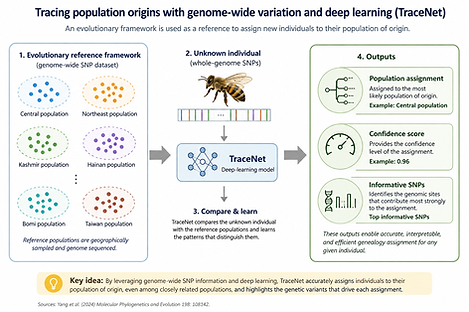
We developed TraceNet, which uses genome-wide variation and deep learning to assign individuals to their population of origin. Across honey bees and other test systems, the method accurately identified geographic lineages, including populations whose evolutionary relationships were difficult to separate using simpler approaches. It can also highlight the genomic sites that contribute most strongly to each assignment (Yang et al. 2024).
The reference framework developed for A. cerana was then applied to bees from Jilong Valley in the Himalayas. Broader sampling revealed that native Jilong bees form a distinct genetic unit that had not been clearly recognized in earlier datasets. They are closely related to Central and Kashmir–Pakistan populations but possess a characteristic genomic composition of their own. Their status as a separate subspecies remains unresolved and requires additional evidence, particularly morphology and denser regional sampling (Liu et al. 2025).
TraceNet distinguished native Jilong bees from other populations and also identified a bee introduced from the Central lineage, demonstrating how evolutionary references can detect both previously overlooked diversity and movement of colonies beyond their native ranges.

Why evolutionary history matters
Reconstructing evolutionary history is more than an exercise in classification. It reveals how independent evolutionary lineages arose and provides the natural experiments needed to understand adaptation.
Without reconstructing that history, we cannot distinguish shared ancestry from repeated adaptation, nor can we understand how contemporary human activities are reshaping future evolutionary potential.