2-2
How Do Honey Bees Adapt to New Environments?
Honey bees originated in warm environments, yet two independently evolving lineages, the Western honey bee Apis mellifera and the Eastern honey bee A. cerana, expanded widely into temperate regions. Cooler climates impose more than an overwintering challenge. Low temperatures restrict flight, foraging and brood care, thereby narrowing the periods during which a colony can acquire food and reproduce. Adaptation to cold therefore increased the conditions under which honey bees could remain active, allowing them to use floral resources across broader geographic ranges, cooler seasons and colder periods of the day.




Multiple paths to environmental adaptation
Closely related honey bees have independently expanded into colder climates and high-altitude environments. These repeated evolutionary events reveal how natural selection assembles physiological, behavioural and microbial mechanisms that allow organisms to thrive under similar environmental challenges.
How does evolution repeatedly build the capacity to adapt?
Producing heat through mitochondrial proton leak
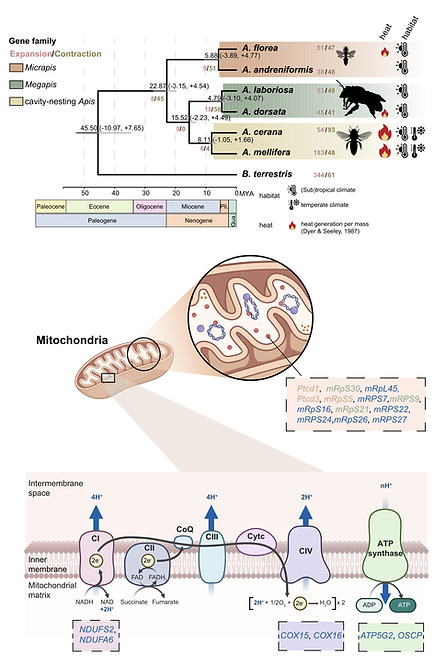
Flight muscles generate heat as they consume energy, but our comparative analyses revealed an additional physiological feature distinguishing the two widespread, temperate-adapted honey bees, A. mellifera and A. cerana, from their tropical relatives. Mitochondria isolated from the flight muscles of these two species showed independently elevated proton leak: instead of using the entire proton gradient to produce ATP, a greater proportion of the stored energy was released as heat. Oxidative phosphorylation itself was not correspondingly elevated, indicating that the enhanced thermogenesis arose specifically through increased mitochondrial uncoupling rather than simply through greater overall respiration.
Comparative genomics identified Ptcd1—which encodes a mitochondrial pentatricopeptide-repeat protein—as a principal molecular component of this convergent adaptation. The same amino-acid substitution, Q208K, evolved independently in the two temperate-adapted honey bees. Functional tests in Drosophila showed that loss of Ptcd1 impaired mitochondrial structure and reduced proton leak and low-temperature heat production. Introducing the honey bee Q208K variant specifically increased proton leak and thermogenesis without increasing mitochondrial abundance or basal oxidative phosphorylation. Our findings demonstrate that convergent molecular evolution of Ptcd1 independently enhanced mitochondrial heat production during the adaptation of the Western and Eastern honey bees to temperate environments (Xiao et al., 2026).
This mechanism appears to have provided an early physiological foundation for temperate expansion. It did not make subsequent adaptation unnecessary. Once honey bees occupied cooler and more topographically complex environments, populations continued to evolve in response to their local conditions.

Refining thermal performance through pigmentation
Body pigmentation provides a second layer of cold adaptation. Darker insects absorb solar radiation more efficiently, allowing passive warming under cool conditions. Across multiple independently evolved high-altitude populations of Apis cerana, we found that darker body colour evolved repeatedly despite their separate evolutionary histories. Remarkably, parallel evolution repeatedly targeted the same pigmentation gene, ebony, but through different molecular mechanisms. In some populations, natural selection acted primarily on the coding sequence, altering protein function, whereas in others it acted on cis-regulatory regions that changed gene expression. Distinct molecular changes therefore converged on the same adaptive phenotype, demonstrating that repeated evolution can exploit different functional regions of a single gene to achieve similar biological outcomes (Qiu et al., 2026, in revision).
Our subsequent work revealed why this evolutionary pattern has broader consequences. In honey bees, ebony regulates not only the degree of body pigmentation but also its developmental plasticity. Temperature-dependent spatial and temporal expression of ebony allows bees developing under cooler conditions to become darker while those developing under warmer conditions remain lighter. Because both traits are governed by the same gene, repeated selection on ebony for constitutively darker pigmentation (whether through coding or regulatory mutations) inevitably reduces the capacity for temperature-induced plasticity. High-altitude populations therefore evolved a coupled phenotype of darkened pigmentation and reduced developmental plasticity. Rather than representing two independent adaptations, reduced plasticity emerges as a predictable consequence of selection acting repeatedly on the same pigmentation gene (Wang et al., 2026; Qiu et al., 2026, in revision).
Why does evolution repeatedly target ebony ?
This finding presents an evolutionary paradox. Developmental plasticity is generally considered advantageous because it allows organisms to adjust their phenotype to changing environments. Why, then, would natural selection repeatedly favour genetic changes that simultaneously increase melanization and reduce plasticity?
Our work suggests that the answer lies in the pleiotropic nature of ebony. Beyond regulating pigmentation, ebony is expressed in glial cells of the honey bee brain, where it modulates dopamine metabolism. Single-cell transcriptomic analyses revealed reduced ebony expression in nectar foragers relative to pollen foragers. Experimentally reducing ebony expression by RNA interference, or increasing dopamine availability, significantly increased nectar intake, demonstrating that ebony regulates feeding preference. We then asked whether the naturally evolved ebony variants differed in function. Transgenic Drosophila carrying the montane honey bee allele consumed more sugar than flies carrying the lowland allele, demonstrating that evolutionary changes in the ebony coding sequence directly alter nectar intake (Yang et al., 2026, under review).

These studies reveal why ebony has repeatedly become an evolutionary hotspot during honey bee cold adaptation. Selection on ebony increases passive heat gain through darker pigmentation, promotes nectar collection through its effects on dopamine signalling, and consequently enhances the energy available for colony thermogenesis. Because pigmentation intensity and developmental plasticity are governed by the same molecular pathway, repeated selection for constitutively darker pigmentation also leads to reduced plasticity. Under persistently cold, high-altitude environments, the benefits of enhanced thermoregulation, together with increased sugar intake through the pleiotropic effects of ebony, appear to outweigh the reduced need for thermal flexibility. At the same time, our ecological niche modelling suggests that this evolutionary strategy may come at a cost: populations with genetically fixed darker pigmentation could become more vulnerable as climates warm, illustrating how adaptation to one environmental regime may constrain responses to future environmental change (Qiu et al., 2026, in revision).

The microbiome supplies additional fuel
Thermal performance is not produced by the bee alone. Honey bees harbor a specialized gut microbiome whose members contribute to energy metabolism under different ecological conditions. Comparing six Apis species revealed that the core bacterium Gilliamella was particularly enriched in the two cold-adapted species, A. mellifera and A. cerana. These hosts also exhibited enhanced genomic and metabolic capacities related to glucose, pyruvate and lipid production, suggesting that host and microbiome evolved complementary metabolic strategies during adaptation to temperate environments (Tang et al., 2025).
The contribution of Gilliamella was tested directly by inoculating microbiota-free bees with a strain isolated from A. cerana. During cold exposure, colonized bees remained more active, maintained higher body temperatures and accumulated more fat than germ-free bees. Colonization with a bacterium from a tropical honey bee did not produce the same effect, demonstrating that improved cold tolerance was not simply a consequence of carrying gut bacteria, but depended on specific microbial functions.
The mechanism lies in complementary carbohydrate metabolism. Gilliamella releases glucose from pollen-derived β-glucan while preferentially degrading glucuronate and galacturonate to generate pyruvate rather than consuming host-accessible glucose. It also converts ascorbate into D-xylulose-5-phosphate, a metabolite associated with lipogenesis. By utilizing alternative carbon sources, the bacterium minimizes competition with the host while increasing the availability of glucose, pyruvate and lipid precursors that support thermogenesis.
Our work further showed that microbiome contributions to cold adaptation extend beyond the core gut community. During overwintering, when bees remain confined to the hive and feed primarily on stored honey, the gut microbiome undergoes a reproducible seasonal reorganization in which the normally rare bacterium Bartonella becomes dominant across multiple honey bee lineages. Unlike the core bacteria, Bartonella is metabolically specialized for winter conditions, utilizing alternative substrates such as lactate, acetate and ethanol to generate pyruvate and acetyl-CoA, while uniquely synthesizing essential amino acids including tryptophan and phenylalanine. These metabolic capacities likely compensate for the protein-poor winter diet and provide additional substrates for host energy metabolism (Li et al., 2022).
These studies demonstrate that honey bee cold adaptation depends not only on host physiology, but also on dynamic metabolic cooperation with distinct members of the gut microbiome that operate across both evolutionary and seasonal timescales.
Adaptation is built in layers
Adaptation to temperate environments did not arise from a single innovation, but through the integration of multiple biological mechanisms operating across evolutionary scales. At the broadest scale, convergent changes in Ptcd1 independently increased mitochondrial proton leak and heat production in the Western and Eastern honey bees. Within these lineages, local populations further refined adaptation through genes such as ebony, whose pleiotropic effects linked body pigmentation and developmental plasticity with nectar-feeding behaviour. At another level, metabolic cooperation with the gut microbiome increased the availability of energy substrates that support fat storage and thermogenesis.
Although these mechanisms act at different biological levels, from genes and metabolism to host–microbiome interactions, they converge on a common outcome: expanding the environmental conditions under which honey bee colonies can remain active. Increased heat production, improved passive warming, more efficient resource acquisition and microbial metabolic support together enabled honey bees to exploit cooler climates that were previously beyond their ecological limits.
Yet adaptation is only one part of the story. The physiological capacities of individual workers ultimately serve the colony, where food, labour and energy must be continuously allocated among brood, adults and stored reserves. This coordination depends on communication between individuals. The next story explores how signals produced by developing larvae reshape worker physiology and behaviour, transforming the responses of individual bees into an integrated colony-level system.

Why adaptation matters
Environmental adaptation determines where organisms can live, when they remain active and how efficiently they acquire resources. Understanding these mechanisms reveals how evolutionary change expands ecological opportunity.
Our work shows that adaptation emerges through multiple interacting mechanisms, from active heat production and passive thermoregulation to behavioural and microbial contributions, rather than through a single "cold-adaptation gene."