2-4
How Do Microbial Partners Shape Honey Bee Adaptation?
A honey bee is not an autonomous biological system. Soon after emergence, workers acquire a specialized gut microbiota through social contact within the colony. These bacteria form a relatively simple community, but their diversity extends far below the genus level, encompassing host-specific species and strains with distinct ecological and metabolic functions.
Our research asks how this microbial community is assembled, how its members coexist, and how their activities become integrated with honey bee physiology and environmental adaptation.

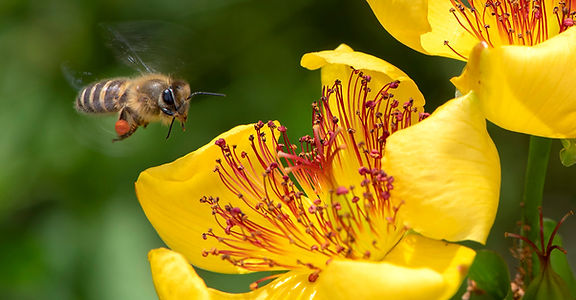


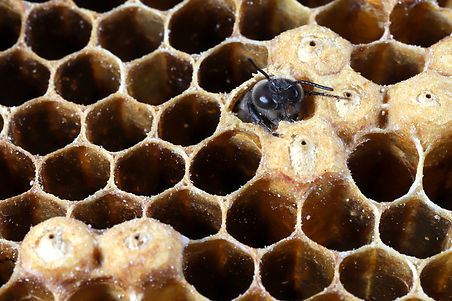
Beyond the honey bee genome
A honey bee is more than its own genome. Specialized microbial partners contribute to nutrition, metabolism, immunity and environmental adaptation, extending the biological system through which evolution shapes organismal function.
How do microbial partners become part of the adaptive process?
Diet links the environment to the microbiota
We first examined gut microbiota variation across geographically differentiated populations of the Eastern honey bee, Apis cerana. Bacterial composition varied among populations at the phylotype, species and strain levels. These differences were not explained by host diversification alone. Pollen diets were significantly associated with both microbiota composition and function, and variation in pollen polysaccharides altered the relative performance of two core bacterial groups, Gilliamella and Lactobacillus Firm-5 (Su et al. 2022).
Seasonal change provided another view of this relationship. During winter, temperate A. mellifera colonies greatly reduce their pollen consumption and rely primarily on stored honey. Across three honey bee subspecies maintained in the same environment, this dietary shift was accompanied by a decline in core bacteria and the seasonal dominance of Bartonella.
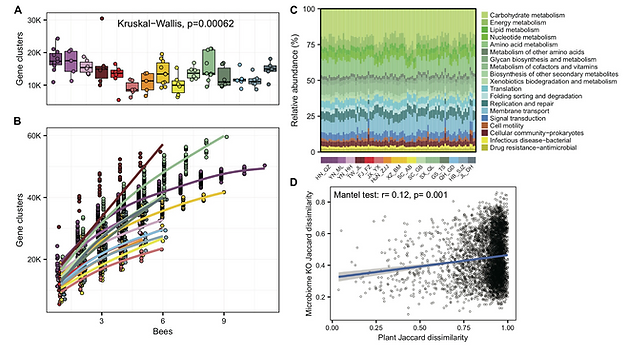
Bartonella could use metabolic wastes such as lactate and ethanol as energy substrates and possessed the capacity to produce and secrete tryptophan and phenylalanine. The study therefore proposed that seasonal microbiota turnover may help compensate for nutritional limitations during winter, although its direct fitness benefit to natural colonies remains to be tested.
These studies showed that the honey bee gut microbiota is evolutionarily stable at the level of its core bacterial lineages, whereas environmental change primarily influences variation among bacterial species and strains. Changes in floral resources and colony nutrition therefore reshape the functional composition of the microbial community rather than its fundamental architecture.
The host selects its microbial partners
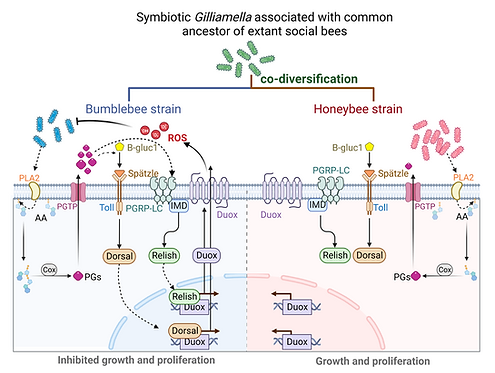
Environmental exposure alone cannot explain which bacteria persist in the bee gut. Honey bees preferentially support their native bacterial partners while restricting closely related strains derived from other hosts.
When honey bees were inoculated with native and bumble bee-derived strains of Gilliamella, the native strain reached substantially higher abundance. The non-native strain induced stronger prostaglandin signalling, activating the IMD and Toll immune pathways. These pathways increased Duox expression and reactive oxygen species (ROS) production, creating a hostile gut environment that restricted the non-native bacterium. The native strain did not survive because it was more resistant to these immune effectors; it avoided triggering the stronger immune response (Guo et al. 2023).
The honey bee immune system therefore serves two functions. It protects the host from pathogens, and it distinguishes compatible symbionts from closely related but non-native bacteria. By preferentially supporting native symbionts while excluding foreign strains, this mechanism helps preserve host-specific gut microbiota across evolutionary history, enabling long-term host–microbiota coevolution.
Microbial communities are built through cooperation and competition
The gut microbiota is also shaped by interactions among bacteria.
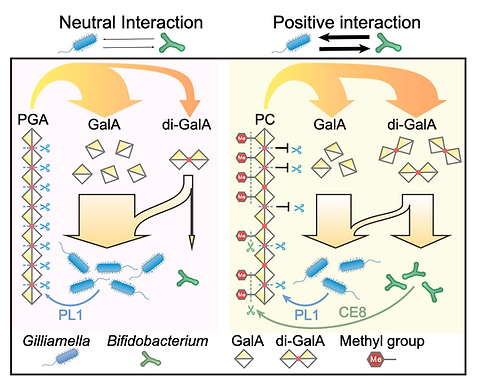
Pollen cell walls contain pectin that the honey bee cannot digest on its own. Gilliamella carries enzymes that break down the pectin backbone, but their activity is inhibited when the substrate is heavily methylated. Bifidobacterium supplies the missing demethylation activity, allowing Gilliamella to complete pectin degradation. In return, Gilliamella releases digestive products that can be used by Bifidobacterium (Tang et al. 2024).
This cooperation depends on the food environment. When the pectin substrate was already demethylated, Bifidobacterium was no longer required and the reciprocal benefit disappeared. Microbial cooperation is therefore not a permanent property of two species; it emerges under dietary conditions that make their functions complementary.
Closely related bacteria must also avoid competitive exclusion. Five predominant Gilliamella species associated with A. cerana have diverged in carbohydrate metabolism. Glycan specialists performed better on pollen-rich diets but were weaker competitors under high-sugar conditions. Their persistence in natural bees was supported by a different life-history strategy: they achieved high biomass yields at low sugar concentrations, allowing them to perform well during periods of nutritional scarcity (Yang et al. 2025).
Fluctuating diets create changing microbial niches. Differences in resource use, competitive ability and life-history strategy allow multiple bacterial species to persist within the same host.

Microbial metabolites regulate honey bee physiology
The consequences of these microbial interactions extend beyond the gut.
Honey bees consume a diet exceptionally rich in sugar, yet they maintain systemic glucose and lipid homeostasis. Bees depleted of their gut microbiota showed reduced insulin-like peptide expression, elevated hemolymph glucose, impaired lipid storage and decreased energy metabolism. Reintroducing the gut microbiota alleviated these symptoms (Han et al. 2024).
Metabolite profiling identified succinate, produced primarily by Lactobacillus Firm-5, as a key signal connecting the gut microbiota to host metabolism. Succinate stimulated gut gluconeogenesis and increased insulin-like peptide expression in the head, thereby regulating carbohydrate and lipid metabolism across the body.
A metabolite produced by one organism can therefore regulate gene expression and physiology in another. The metabolic phenotype of a worker bee depends not only on its own genome, but also on biochemical signals generated by its microbial partners.
Microbial metabolism contributes to cold adaptation
This regulatory relationship becomes especially important under environmental stress.
Comparisons across six Apis species showed that Gilliamella was most strongly enriched in the Western honey bee, A. mellifera, and the Eastern honey bee, A. cerana, the two lineages that expanded naturally into temperate environments. Experimental colonization of microbiota-free bees with Gilliamella increased activity, body temperature, and fat storage, thereby enhancing cold tolerance.
The interaction involved complementary carbohydrate metabolism. Honey bees increased their capacity to acquire and use glucose and pyruvate while providing glucuronate and ascorbate to Gilliamella. The bacterium converted these substrates into metabolites that supported host lipogenesis and energy production while limiting direct competition with the host for glucose (Tang et al. 2025).

This microbial mechanism complements the intrinsic heat-production mechanisms described in our earlier work. Honey bee thermogenesis is supported by the host’s own metabolic machinery, but the energy available to that machinery can be increased through metabolic exchange with gut bacteria.
The microbiota also prepares the host for infection
The host immune system regulates which bacteria can colonize the gut, but regulation also operates in the opposite direction.
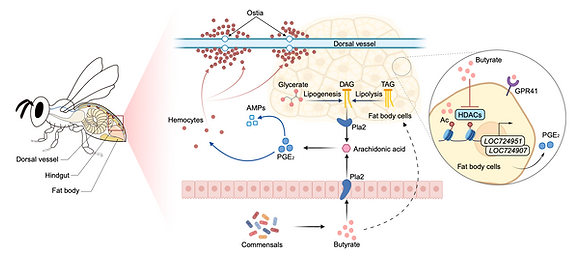
Honey bees carrying living gut bacteria survived pathogenic infection better than germ-free bees or bees inoculated with heat-killed bacteria. They mounted faster systemic responses, including antimicrobial peptide expression and the aggregation of hemocytes around the dorsal vessel. These results showed that metabolic activity from living bacteria, rather than bacterial structures alone, was required for the full protective effect.
The key microbial metabolite was butyrate. Butyrate acted through G-protein-coupled receptor 41 and inhibition of histone deacetylases to reprogram glycerolipid and arachidonic acid metabolism in the fat body. This increased prostaglandin E2 production, which activated both humoral and cellular immunity. Butyrate supplementation restored much of the immune competence of germ-free bees and improved their survival following infection (Liu et al. 2026).
The relationship between honey bees and their microbiota is therefore reciprocal. Host immunity filters microbial partners, while microbial metabolites regulate host metabolism, thermogenesis and systemic immunity.
Adaptation extends beyond the organism
Honey bee adaptation emerges from interactions among environmental resources, microbial communities and host physiology.
Diet determines which microbial functions are favoured. Host immunity determines which bacterial partners can persist. Interactions among bacteria determine how complex nutrients are degraded. Microbial metabolites then alter host metabolism, heat production and pathogen defence.
Natural selection can consequently act not only on honey bees and bacteria as separate organisms, but also on the compatibility and metabolic exchange that connect them. The adaptive capacity of the honey bee resides partly in its own genome and partly in the biological community it carries.
From Human Impacts to Biological Resilience
Human activities continue to reshape the environments in which honey bees live. Understanding their long-term resilience therefore requires looking beyond changes in the bee genome itself. Every worker carries a specialized community of gut microbes that has coevolved with its host for millions of years. These microbial partners influence nutrition, metabolism, immunity and environmental adaptation, extending the biological system through which honey bees respond to changing environments.

Why microbial partners matter
Honey bees do not function through their own genomes alone. Their specialized gut microbiota contributes to nutrition, metabolism, immunity and environmental adaptation, forming an integrated biological partnership with the host.
This partnership reveals that adaptive capacity can emerge from interactions between host and microbial genomes rather than from either partner independently.