
OBSERVING COMMUNITIES
Ecological interactions cannot be understood using a single observation or a single technology.
Our observatory integrates biodiversity surveys, molecular ecology and genomics to reconstruct ecological communities from multiple complementary perspectives.
Introduction
Ecological communities are built from countless interactions among plants, pollinators and other organisms. Many of these interactions are transient, difficult to observe directly, or occur at spatial and temporal scales beyond a single field survey. Understanding how communities respond to environmental change therefore requires multiple complementary approaches that capture different aspects of ecological organization.
Our research combines traditional natural history with biodiversity genomics to build a comprehensive picture of ecological communities. Standardized field sampling, molecular analyses and long-term monitoring generate complementary datasets that can be integrated to reconstruct ecological interactions with increasing completeness and resolution.
How do we document biodiversity?
Species inventories provide the foundation for every ecological study. We document both pollinators and flowering plants using standardized field protocols designed for long-term monitoring.
Insects
-
Hand-net collections
-
Malaise traps
-
Pan traps
-
Standardized metadata
-
Voucher specimens
-
DNA barcoding and genomic references
Plants
-
Pressed voucher specimens
-
Leaf tissues preserved for DNA
-
Pollen collections
-
Chloroplast genome copy-number analyses
-
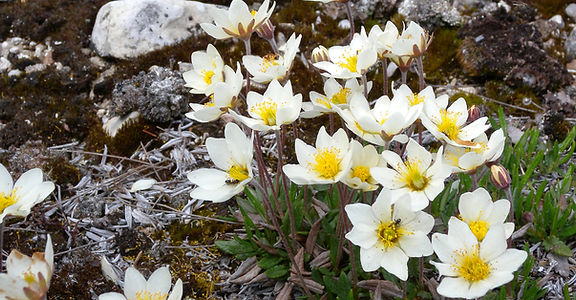
Flowering phenology

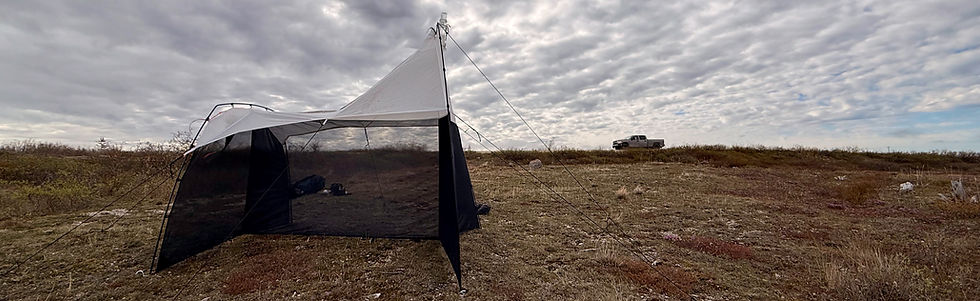
Pan traps (front) and Malaise traps (back) are used to collect insects in Churchill
How do we reconstruct ecological interactions?
Different approaches provide complementary perspectives on ecological interactions. Direct observations reveal behaviour and flower visitation, whereas molecular analyses recover additional evidence from pollen, gut contents and environmental DNA. Integrating these datasets enables more complete reconstruction of pollination networks.
Our observatory integrates multiple independent lines of evidence to infer plant–pollinator interactions.

Direct observations
-
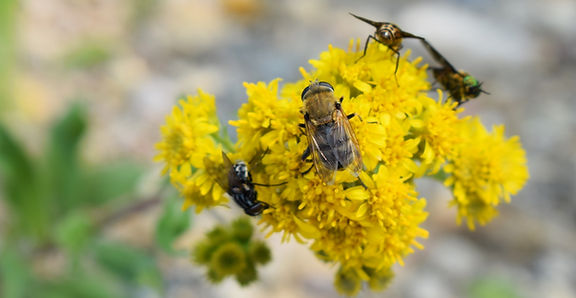
Flower visitation observations
-
Photographic records
-
Public science: iNaturalist
Molecular evidence
-
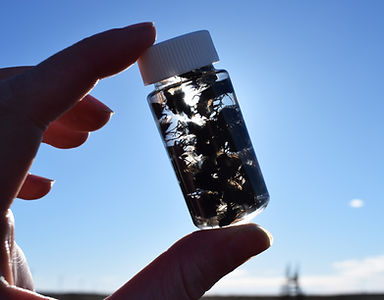
Body pollen carried by insects
-
Gut-content analysis
-
Flower environmental DNA (eDNA)
-
DNA metabarcoding
-
Pollen genome skimming
Integrated inference
These complementary datasets are combined to reconstruct ecological interaction networks that are more complete and robust than any single method alone.
How do we transform annual surveys into a long-term ecological observatory?
Ecological communities are constantly changing. Some changes occur over days or weeks as flowering progresses through the short Arctic summer, while others unfold gradually over years as climates warm and species distributions shift. Distinguishing temporary fluctuations from lasting ecological change requires observations that are collected consistently over long periods of time.
Rather than treating each field season as an independent biodiversity survey, our observatory follows standardized protocols that allow every new observation to be directly compared with previous years. Sampling locations, collection methods, specimen preservation, environmental metadata and molecular analyses are all designed to remain consistent through time, creating an expanding ecological record rather than isolated datasets.
By returning to the same landscapes year after year, we can ask questions that cannot be answered from a single season.
Repeated ecological observations
-
Permanent sampling sites across representative habitats
-
Repeated flowering phenology throughout the growing season
-
Annual pollinator surveys using standardized protocols
-
Long-term monitoring of environmental conditions
-
Consistent collection of voucher specimens

Permanent biodiversity collections
Every specimen collected contributes to a permanent scientific resource.
Plants are preserved as herbarium vouchers, while insects are archived in curated collections and linked to genomic reference libraries. These collections provide an auditable record of biodiversity that can be revisited as taxonomy, sequencing technologies and ecological questions continue to evolve.
Building an ecological time series
Each field season adds another layer to the observatory.
Because ecological observations, biodiversity inventories and molecular data are collected using consistent protocols, community structure can be compared directly across years. This allows us to distinguish seasonal variation from long-term ecological reorganization, revealing how pollination networks respond to continuing environmental change.
From observation to prediction
The ultimate goal extends beyond documenting ecological change.
As the observatory grows, repeated observations will provide the foundation for understanding which ecological interactions remain stable, which are reorganized under environmental change, and which are essential for maintaining resilient communities. By integrating long-term ecological monitoring with biodiversity genomics, we aim to transform descriptive biodiversity surveys into predictive ecological science.
From evolution to ecology
Ecological communities are not simply collections of species—they are assembled from organisms with distinct evolutionary histories, adaptive capacities and ecological functions. Our long-term vision is to integrate biodiversity genomics, evolutionary biology and organismal ecology with community-level observations, allowing us to understand not only how ecological networks change, but also why different species contribute differently to community resilience. By linking processes across biological scales, from genes and genomes to organisms, interactions and ecosystems, we seek to build a predictive framework for understanding biodiversity in a changing world.

Building a living observatory
Long-term ecological observatories depend on standardized methods, permanent biodiversity collections and repeated observations that accumulate into a lasting scientific resource.
But scientific infrastructure alone is not enough. The success of a long-term observatory ultimately depends on the people who build, maintain and expand it across generations.